



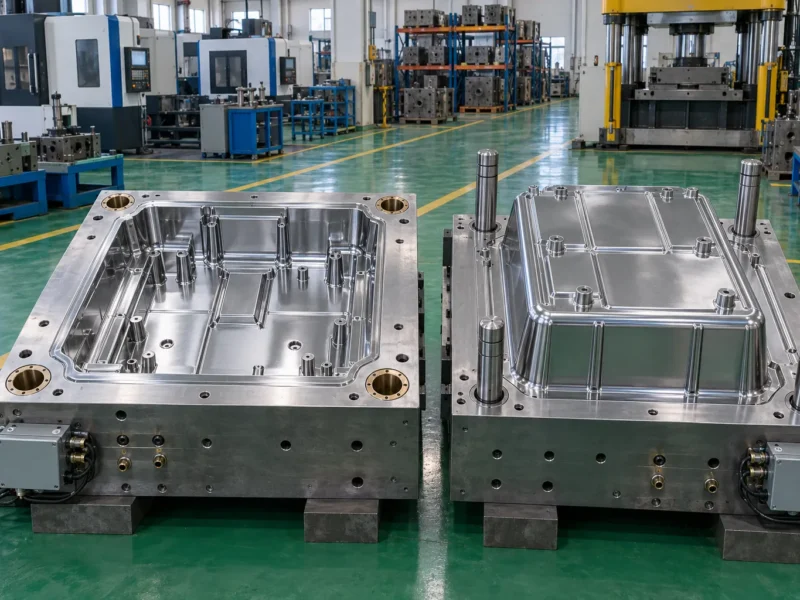
There is no list price for an SMC mold: two molds for parts of the same size can differ several times in cost. What sets the price is the work and material that go into the tool. This guide explains the main cost drivers and what to look for when you compare quotations.
The main cost drivers
| Driver | Why it changes the price |
|---|---|
| Part size and projected area | A larger part needs a larger, heavier mold block and more machining. The mold also has to match the platen size of the press. |
| Part complexity | Deep ribs, undercuts, core pulls, many holes and inserts add mold components and machining time. |
| Steel | Pre-hardened steel is quicker to machine; hardened or premium steels cost more but last longer and resist wear from glass fibers. |
| Shear edge construction | Hardened or insert-type shear edges add cost but keep flash under control over a long production run. |
| Surface finish | High polish, chrome plating and textures add finishing work. |
| Heating system | Oil or steam channels, or electric heaters with zones and controls, are part of the mold cost. |
| Ejection and vacuum | Air ejection, vacuum systems and many ejector pins add components. |
| Expected volume | A mold for a few thousand parts can use simpler construction than one for long, high-volume production. |
Costs that are not in the mold price
- Trials and samples: trial runs, compound for trials and sample parts.
- Design changes: changes after the mold design is approved.
- Fixtures: cooling fixtures for flatness, machining and inspection fixtures.
- Shipping: crating and freight if the mold is shipped to your plant.
How to compare quotations
- Check that each supplier quotes the same part revision, compound and volume.
- Compare the mold specification line by line: steel, hardness, shear edge, plating, heating, ejection and expected life.
- Ask what is included: DFM report, mold flow or charge study, trials, samples and inspection reports.
- Look at the part price and the mold price together. A better mold often gives a shorter cycle, less deflashing and fewer rejects.
How to reduce mold cost
- Simplify undercuts and side features where the function allows.
- Make walls uniform and ribs moderate, following the SMC mold design guide.
- Machine some holes after molding instead of adding many core pins, when tolerances allow.
- Match the mold construction to the real lifetime volume.
A written mold specification is what makes two quotations comparable. Send us your part for a DFM review and a quotation against a written specification.
Frequently asked questions
Why are SMC molds more expensive than some injection molds?
SMC molds are often large and heavy, need a precise hardened shear edge, chrome-plated surfaces and a heating system, and must withstand abrasive glass fibers. Size and construction, not the process name, drive the cost.
Who owns the mold?
Normally the customer who pays for the mold owns it. Ownership, maintenance and storage terms should be written into the quotation or the tooling agreement.
Does a more expensive mold give cheaper parts?
Often, at volume. Better heating, shear edges and ejection give shorter cycles, thinner flash and fewer rejects, which lowers the cost of every part.
Have a BMC or SMC part to discuss? Send your drawing or 3D file through our inquiry form. Our engineers reply with DFM comments and a quotation.