



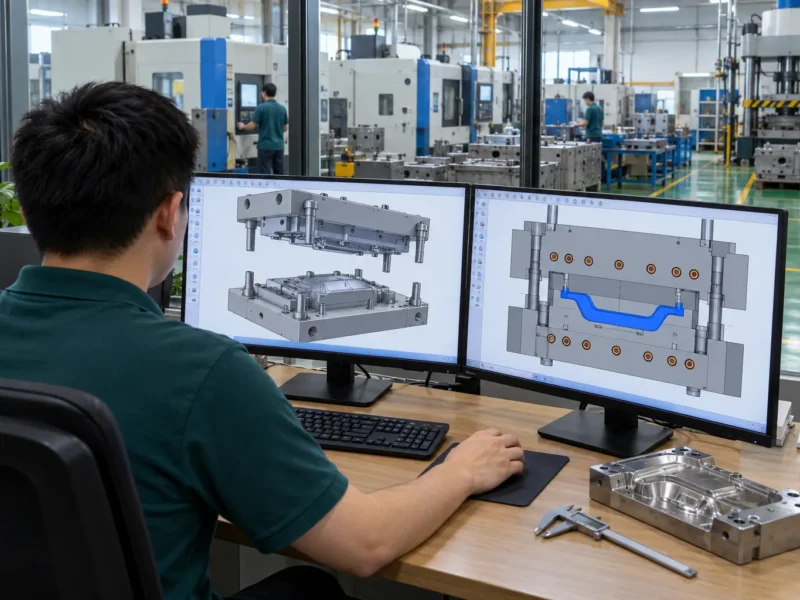
Good SMC parts start with a part design that suits compression molding and a mold built around it. This guide lists the points our engineers check in a DFM review. Values are typical starting points; the final numbers depend on the compound, the part and the press.
Part design
| Feature | Typical guideline | Why |
|---|---|---|
| Wall thickness | About 2–6 mm, as uniform as possible | Even flow and cure; thick sections cure slowly and can blister |
| Thickness changes | Gradual transitions | Abrupt steps cause flow marks and stress |
| Ribs | Root thickness typically no more than about 0.75 of the wall, with root radii | Limits sink marks on the show surface |
| Rib height | Moderate; deep ribs need venting or vacuum | Air trapped at the rib tip causes porosity |
| Bosses | Cored out and tied into walls with ribs | Avoids thick, slow-curing masses |
| Draft | Typically 1–3° per side, more for texture | Clean release of a hot, rigid part |
| Corners | Generous inside and outside radii | Better flow and fewer cracks |
| Holes | Molded with core pins or machined after molding | Molded holes save cost; machined holes give tighter tolerances |
| Inserts | Metal inserts with anchoring features | Secure fixing for threaded connections |
Mold design
Shear edge
The shear edge is the telescoping fit between the two mold halves at the edge of the part. Its clearance is kept tight, typically about 0.05–0.10 mm per side, so the compound is trapped and the flash stays thin and easy to remove. Glass fibers wear the shear edge on every cycle, so it is hardened or made as inserts that can be reground or replaced.
Heating
The mold is heated by electric cartridge heaters or by oil or steam channels. The layout aims for an even surface temperature, typically about 140–160 °C, on both halves, often with the two halves set a few degrees apart. Hot and cold spots show up as uneven cure, gloss differences and warpage.
Surface
Cavity and core surfaces are polished and usually hard-chrome plated, typically a few hundredths of a millimeter thick. Chrome helps the cured part release, resists the abrasion of the glass fibers and keeps the surface finish consistent; worn chrome can be stripped and re-plated. Textured surfaces are possible but need more draft.
Stops and thickness control
Stops or parallels between the mold halves fix the final part thickness, so the part does not get thinner or thicker with small changes in charge weight.
Ejection and venting
Ejector pins or air ejection push out the hot part without marking the show surface. Vents or vacuum assistance remove air from deep ribs and the end of flow.
Charge pattern
The charge usually covers about 40–70% of the projected area and is placed so that the compound reaches all edges at about the same time. Flow length, knit lines and fiber orientation are planned together with the part designer.
A checklist before releasing the design
- Is the process confirmed: SMC compression, or would BMC suit the part better? See BMC vs SMC vs thermoplastics.
- Are walls uniform and ribs thinner than walls?
- Is there enough draft for the surface finish?
- Are critical dimensions and flatness requirements defined?
- Are holes, inserts and machining operations clear on the drawing?
- Is the expected volume known, so steel and construction can be matched? See what drives the cost of an SMC mold.
Frequently asked questions
What is a shear edge in an SMC mold?
It is the telescoping fit between the mold halves at the part edge. A tight, even clearance traps the compound and keeps flash thin.
Why do SMC parts get sink marks over ribs?
A rib that is as thick as or thicker than the wall creates a thicker section at its root, which shrinks more. Thinner ribs with root radii reduce sink.
How much draft does an SMC part need?
Typically 1–3° per side for smooth surfaces, more for textured or very deep walls.
Have a BMC or SMC part to discuss? Send your drawing or 3D file through our inquiry form. Our engineers reply with DFM comments and a quotation.