



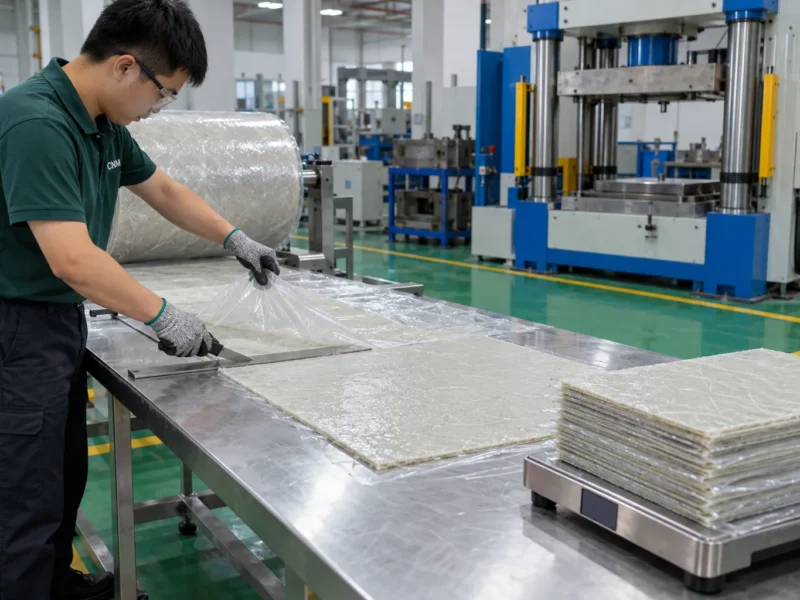
Sheet molding compound (SMC) is a ready-to-mold, glass-fiber-reinforced thermoset material supplied as a sheet. It is compression molded in a heated steel mold into strong, stiff parts such as electrical enclosures, meter boxes, automotive panels, EV battery covers and water tank panels.
What SMC is made of
An SMC sheet is a paste of thermoset resin and fillers with chopped glass fibers laid into it, held between two carrier films. A typical formulation contains:
- Resin: usually unsaturated polyester; vinyl ester or other resins for higher chemical or heat resistance.
- Glass fibers: chopped rovings, typically about 25 mm long; often about 25–30% by weight in general-purpose grades and more in structural grades.
- Fillers: mostly calcium carbonate, plus alumina trihydrate in flame retardant grades.
- Additives: an initiator for the cure, a thickener (typically magnesium oxide) that turns the paste into a handleable sheet, an internal mold release, low-profile additives for low shrinkage and smooth surfaces, and pigments.
After compounding, the sheet is left to mature, typically for one to a few days, while the thickener raises its viscosity until the sheet can be handled and cut. It then has to be stored cool, sealed in its films, and molded within its shelf life.
How SMC parts are molded
- The sheet is cut into plies and stacked into a charge. The charge usually covers only part of the mold surface, commonly about 40–70% of the projected area, and flows out to fill the rest.
- The charge is placed on the hot lower mold half; typical mold temperatures are about 140–160 °C.
- The press closes and applies pressure, typically about 5–15 MPa on the projected area of the part. The charge flows outward and fills the cavity.
- The part cures under heat and pressure, typically in under a minute to a few minutes depending on wall thickness.
- The mold opens and the hot, rigid part is ejected, then deflashed and, if needed, machined or painted.
The process and the molds are covered in more detail in our pages on compression molding and SMC compression molds.
Properties of SMC
| Property | What it means for the part |
|---|---|
| High stiffness and strength | Long glass fibers carry load; parts can replace sheet metal and some castings. |
| Heat resistance | Cured thermoset does not melt; parts keep their shape at temperatures where many thermoplastics soften. |
| Dimensional stability | Low shrinkage and low creep; flat panels and accurate mounting points. |
| Corrosion and weather resistance | No rust; suitable for outdoor enclosures and wet environments. |
| Electrical insulation | High dielectric strength for enclosures and switchgear parts. |
| Flame retardance | Available in grades formulated for ratings such as UL 94 V-0 at a stated thickness. |
| Design freedom | Ribs, bosses, holes and inserts in one molded part. |
Property values depend on the grade; the supplier’s data sheet gives the figures for a specific compound.
Where SMC is used
- Electrical and power: meter boxes, distribution enclosures, switchgear panels, cable trays.
- Automotive and EV: body and underbody panels, tailgates, battery covers and enclosures.
- Construction and water: sectional water tank panels, covers and gratings.
- Sanitary: shower trays and bathtubs.
For smaller, more detailed parts the related compound BMC is often the better choice. See BMC vs SMC vs thermoplastics.
Frequently asked questions
What is the difference between SMC and fiberglass?
Both are glass-fiber-reinforced resins. “Fiberglass” usually means parts laid up by hand or sprayed in an open mold; SMC is a pre-made compound pressed in a closed, heated steel mold, which gives faster cycles, two finished sides and repeatable dimensions. See SMC vs fiberglass hand lay-up.
How long does an SMC part take to mold?
The cure time is typically from under a minute to a few minutes, mainly depending on wall thickness. Loading the charge and removing the part add to the cycle.
Can SMC parts be painted?
Yes. SMC parts are primed and painted for appearance or UV protection; pigmented grades also give molded-in color.
Have a BMC or SMC part to discuss? Send your drawing or 3D file through our inquiry form. Our engineers reply with DFM comments and a quotation.